
Wayne County Projected Versus Actual Release
A projected release date is a calculated point in a sentence record. It is not the same as the day and time a person actually leaves a facility. Missouri’s public offender-data descriptions use the more exact labels Sentence-I Minimum Release Date and Sentence Maximum Release Date. The minimum is a MODOC calculation on an active sentence. The maximum is the maximum release or expiration date. Neither field, standing alone, records the physical door-out event.
County custody works differently. A person awaiting trial at Wayne County Jail has no set sentence-based release date. The next event may turn on bond, a judge’s order, dismissal, a plea or sentence, or transfer to another custodian. A person serving a local sentence may have a computed end point, but Wayne County has no verified public good-time policy or online jail-sentence calculator. The sentencing order, jail-credit calculation, sheriff, and court are the correct sources.
Find a Wayne County Release Date
First determine whether the person is in the Wayne County Jail or the statewide Missouri prison system. The MODOC Offender Web Search is a statewide active-offender tool. It covers incarcerated people, probationers, and parolees, but not finally discharged offenders. It does not cover every Wayne County booking. A local bond-out who never entered DOC custody or supervision will not gain a MODOC release date merely because the criminal case began in Wayne County.
- Identify the custodian. Call the Wayne County Sheriff for a local jail case. Use MODOC for a person committed to state prison.
- Match the person. In the MODOC search, use the DOC number when known. Otherwise compare the name, aliases, cause number, and sentencing county.
- Read the field label. Distinguish Sentence-I Minimum Release Date, Sentence Maximum Release Date, assignment, and Completed Flag.
- Review all sentences. Multiple cause numbers or consecutive terms can make one sentence row misleading when read alone.
- Confirm the result. Ask MODOC or the Wayne County Sheriff whether the date is current and whether another hold, transfer, or supervision term follows.
The search is CAPTCHA-gated and shows a data-current timestamp. A no-result has several possible causes, including final discharge, spelling or identity mismatch, a protected record, or no MODOC history. For a past Wayne County prison case, move to the MODOC Sunshine current/former-offender data or make a focused request.
For a local booking, the Wayne County released-inmate record process covers the sheriff request and court cross-check. It can establish a past release date or transfer that a live jail roster no longer shows.
Wayne County MODOC Release Fields
Missouri’s downloadable offender data gives a Wayne County search more context than a generic projected-date label. The file can include the lifelong DOC ID, assigned place, location function, court cause number, sentencing county, sentence length, probation details, minimum and maximum release fields, and a Completed Flag. The sentencing county code WAYN can preserve the Wayne link even when the person is housed or supervised elsewhere.
| Official field | What it supports | What it does not prove |
|---|---|---|
| Sentence-I Minimum Release Date ($PC) | MODOC’s calculated minimum date for an active sentence | The guaranteed physical exit date |
| Sentence Maximum Release Date ($PD) | Maximum release or sentence-expiration point | That the person stays confined until that date |
| Location function F | A field assignment that generally indicates community supervision | The exact date confinement ended |
| Location function I | An institutional assignment supporting current confinement | Why or when the next release will occur |
| Completed Flag Y | Completion of that sentence record | Completion of every other sentence or case |
| Sentencing county WAYN | A Wayne County link for the sentence | Current confinement inside Wayne County |
The official field-description source is captured below. The record should be read across assignment, sentence, county, and completion fields instead of relying on a single date.
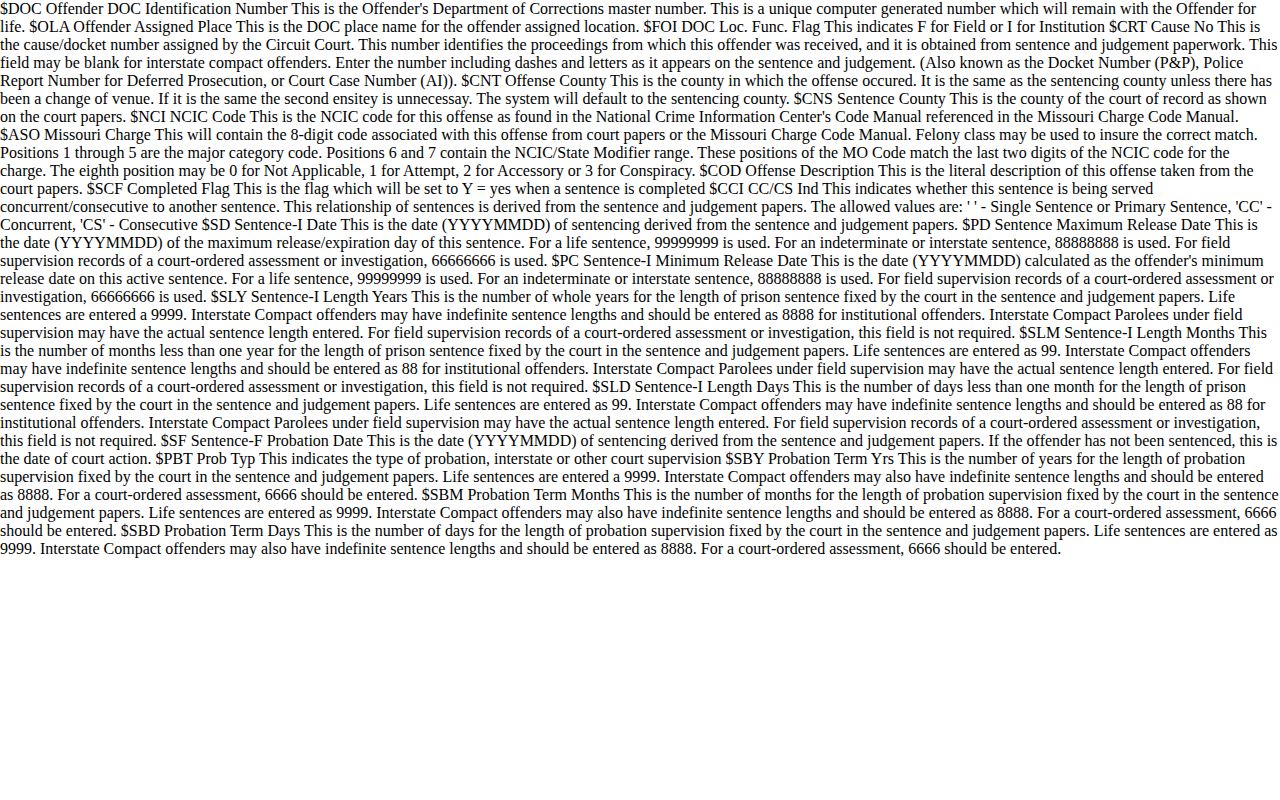
The image shows the official data labels that govern a Wayne County state-offender date check. It does not replace confirmation from MODOC.
Wayne County Minimum Prison Terms
Missouri does not apply one 85-percent rule to all prison sentences. Under §558.019(3), a person convicted of a dangerous felony as defined by §556.061 and committed to MODOC must serve 85 percent of the court-imposed sentence, or reach the statute’s age and service alternative. The qualifying offense and current statutory text must be checked. A Wayne County conviction for some other offense should not be placed under that rule by assumption.
For certain repeat MODOC commitments on non-dangerous felonies, §558.019(2) sets minimum terms of 40 percent with one prior commitment, 50 percent with two, and 80 percent with three or more. Definitions and age alternatives matter. Subsection 5 treats the minimum prison term as time before eligibility for parole, conditional release, or another early release by MODOC. Eligibility opens a legal possibility. It does not compel release on that day.
The official statute view gives the qualifying language and repeat-commitment rules.
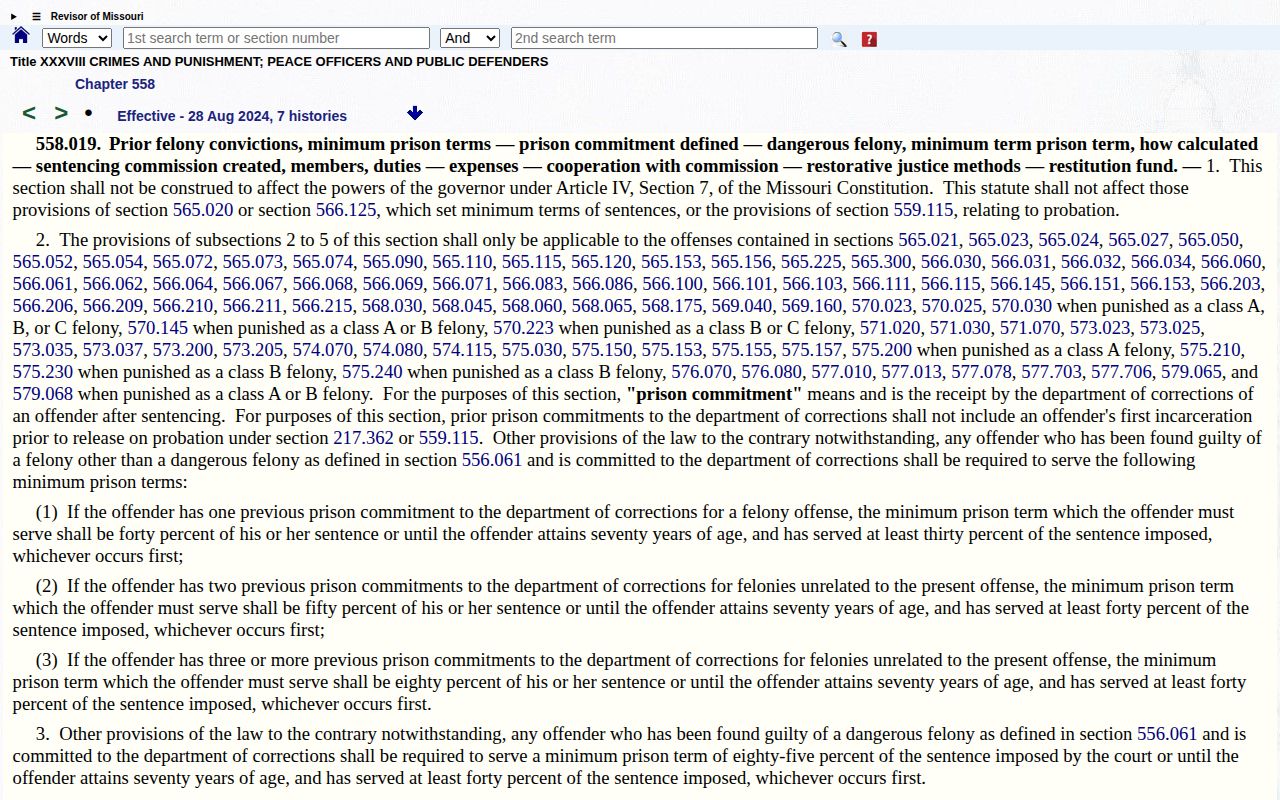
The statutory categories explain why a raw sentence length cannot be converted into one universal Wayne County projected release formula.
Note: Confirm the offense, commitment history, judgment, and current statute before applying a percentage to any Wayne County prison term.
Wayne County Conditional Release Calculation
For an eligible felony term, §558.011 divides the sentence into a prison term and a conditional-release term. For a term of nine years or less, the conditional-release portion is one-third. For a term over nine through fifteen years, it is three years. For a term over fifteen years, it is five years. The prison portion is the remainder.
That arithmetic is only one part of the result. Statutory exclusions and minimum-term laws may alter its practical effect. Conditional release is release from prison under conditions to Probation and Parole supervision. The Board may extend the conditional-release date, up to the full sentence, after institutional rule violations through the process set out in the statute. A calculated date therefore remains conditional.
The conditional-release statute is shown in the matching manifest image below.
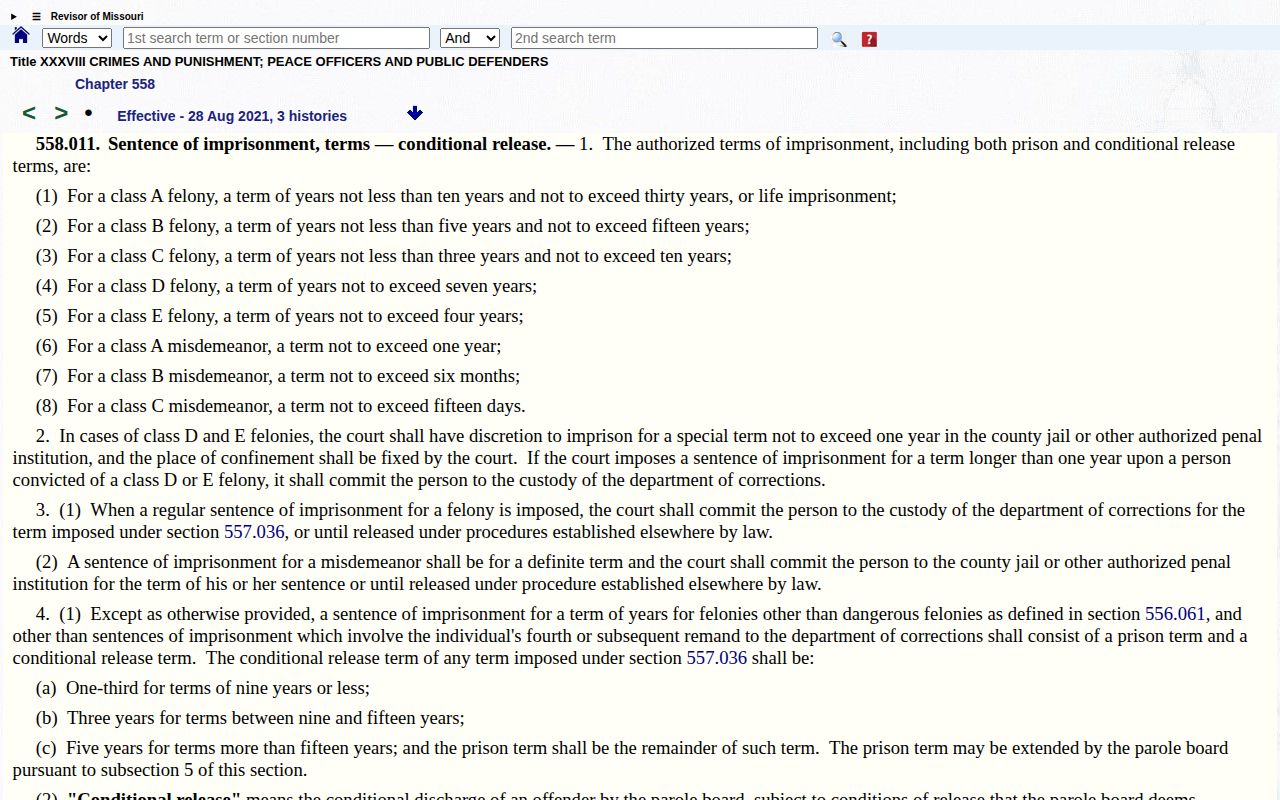
The statute divides eligible terms, but MODOC and the Board remain the sources for the live calculation and any extension.
Wayne County Good-Time Distinctions
Missouri earned compliance credit is not prison good time. Under §217.703, eligible people already on probation, parole, or conditional release can receive 30 days of credit for a full compliant calendar month, subject to exclusions. No credit accrues in specified noncompliant months or while the person is absconding. The credit can advance final discharge from supervision, not the day the person exits an institution.
For a Wayne County Jail sentence, no county good-time policy or local calculation rule was verified. Use the sentencing order, any jail-credit calculation, and confirmation from the sheriff or court. Ask whether the working date includes time already credited and whether another agency has lodged a hold. Do not apply MODOC’s dangerous-felony percentages or state sentence-field labels automatically to a short local jail term.
Why Wayne County Release Dates Change
A date can change even when the source was read correctly. MODOC may recalculate a sentence after new data, and one row may not reflect every active cause number. Board action can affect parole or conditional release. Institutional violations can alter the conditional-release path. A court order, another sentence, or a detainer can keep a person in custody after one case reaches its release point.
| Factor | Possible effect | Where to confirm |
|---|---|---|
| Consecutive or multiple sentences | One minimum date may not control the full custody period | MODOC sentence rows and court judgments |
| Institutional violation | Conditional release may be extended through the statutory process | MODOC and Missouri Parole Board |
| Parole decision | Eligibility may not result in release, or conditions may follow release | Board and active MODOC record |
| Detainer or other hold | Release from one authority may become transfer to another | Current custodian and receiving agency |
| Court order or corrected credit | The legal or calculated end point may move | Case.net, clerk, MODOC, or sheriff |
| Final sentence completion | Completed Flag may change when the sentence is closed | MODOC current/former data |
A person who leaves Wayne County Jail for MODOC, another county, federal custody, or another authorized custodian has been transferred, not necessarily released to the community. Ask for the receiving agency when that information is public.
Confirm Wayne County Actual Release
For a state prisoner, ask MODOC whether the minimum field is still current and whether parole, conditional release, or another hold follows. Its Constituent Services contact page asks for the correct full name, DOC number, birth date or other identifying facts, and an exact question. The page describes ordinary responses as usually provided within 24 hours during business hours, but that is not a guaranteed Sunshine Law deadline.
For the Wayne County Jail, call the sheriff at 573-224-3219. Ask whether the named person is still in local custody, was released to the community, or was transferred. For a past event, request the booking and release record with the approximate date range. The sheriff’s actual release time answers a different question from MODOC’s sentence minimum.
MOVANS can add a custody-change alert. Missouri DPS provides VINELink, telephone registration at 866-566-8267, and the VINE mobile app. The Wayne County VINELink release check explains the specific-person alert route. MOVANS depends on custodian data and is not a permanent release certificate, so verify the reported event with the sheriff, MODOC, or court.
Note: A release alert is a prompt to confirm the event, while the agency record identifies whether the event was community release or transfer.